

What is air-blown micro optic fiber cable?
Air-blown fiber systems, or jetting fiber, are highly efficient for installing fiber optic cables. Using compressed air to blow micro-optical fibers through pre-installed microducts allows for quick, accessible installation, even in hard-to-reach areas. It's ideal for networks that require frequent updates or expansions, as it enables duct installation without initially determining the exact fiber need, reducing the necessity for dark fibers. This approach also minimizes optical loss and enhances system performance, offering a cost-effective and flexible solution for modern fiber optic networks.
Types of air-blown micro optic fiber cable
Air-blown micro cables come in various types, each designed to meet specific needs and applications in fiber optic networks.
Here are theprimary types:
 |
EPFU | Enhanced Performance Fibre Units Air-Blown Micro Optical Fiber Cable For FTTx Network FTTH |
 |
GCYFXTY | Uni-tube Air-Blown Micro Optical Fiber Cable For FTTx Network Power system Lightingprone areas |
 |
GCYFY | Stranded Loose Tube Air-blown Micro Fiber Optic Cable for FTTH Metropolitan area Access networks |
 |
MABFU | Micro air-blown fiber units |
 |
SFU | SFU Smooth Fiber Units |
 |
Micro Module Cable | Outdoor & Indoor Micro Module Cable |
Air-blown micro cables offer several advantages, particularly in the context of fiber optic networks. Here are some key benefits:
Flexibility in Installation: Air-blown micro cables can be easily installed in existing duct systems, which allows for flexibility in network design and expansion. This reduces the need for new duct installations and can be particularly useful in urban environments where space is limited.
Reduced Initial Investment: Since the cables are blown into place as needed, the initial investment can be lower. Network operators can install the ducts first and then blow in the cables as demand increases, spreading out the cost over time.
Scalability: These cables make it easy to scale the network. Additional cables can be blown into the ducts without significant disruption to the existing infrastructure. This scalability is particularly beneficial for growing or evolving networks.
Speed of Deployment: Air-blown cable systems can be deployed quickly, reducing the time required for installation and minimizing disruption to the area. This is especially advantageous in time-sensitive projects.
Less Physical Strain on Cables: The blowing process reduces physical strain on the cables during installation, which can help maintain the integrity and performance of the fiber optics over time.
Ease of Maintenance and Upgrades: Maintenance and upgrades are simplified since cables can be added or replaced without digging up roads or disrupting existing infrastructure. This also minimizes downtime and service interruptions.
Improved Performance: Air-blown micro cables are designed to be lightweight and have low friction, which facilitates smoother installation and can result in better performance of the fiber optic network.
Cost-Effective Repairs: In case of damage, only the affected section of the cable needs to be replaced, rather than the entire length. This targeted repair approach can save costs and reduce downtime.
Future-Proofing: Installing a duct system that can accommodate future air-blown cables allows network operators to be prepared for future technology advancements and increased data demands without significant additional infrastructure changes.
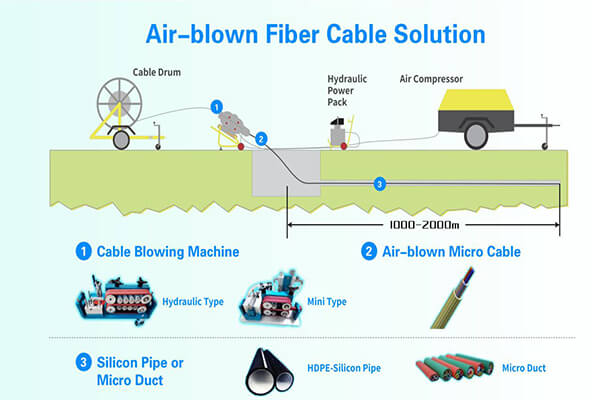
Overall, air-blown micro cables provide a versatile, cost-effective, and scalable solution for building and maintaining modern fiber optic networks.
For More Information or datasheet of our air blowing fiber cables, pls contact with our sales or technical team via email: [email protected];