
The optical fiber industry is at a turning point. For decades, conventional solid-core fiber has served as the backbone of global communications. But as AI workloads explode, data center traffic surges, and latency-sensitive applications multiply, the limitations of traditional silica fiber are becoming impossible to ignore.
Enter hollow core fiber (HCF) – a transformative technology that replaces the solid glass core with an air-filled hollow region, allowing light to travel faster, farther, and with less signal degradation. At GL FIBER, we specialize in anti-resonant hollow-core optical fiber and hollow core fiber cable solutions designed to meet the demands of next-generation networks. Here’s what you need to know.
What Is Hollow Core Fiber – and Why Does It Matter?
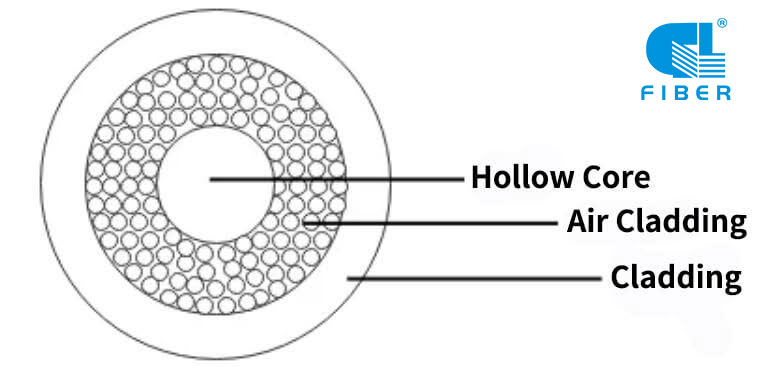
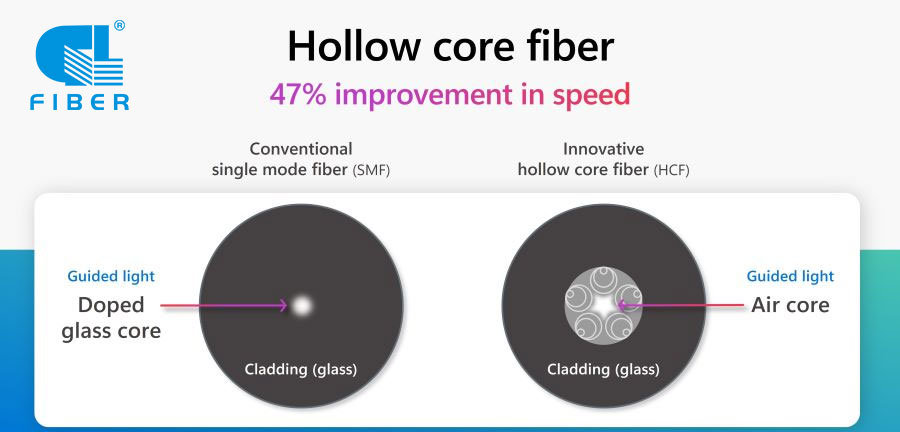
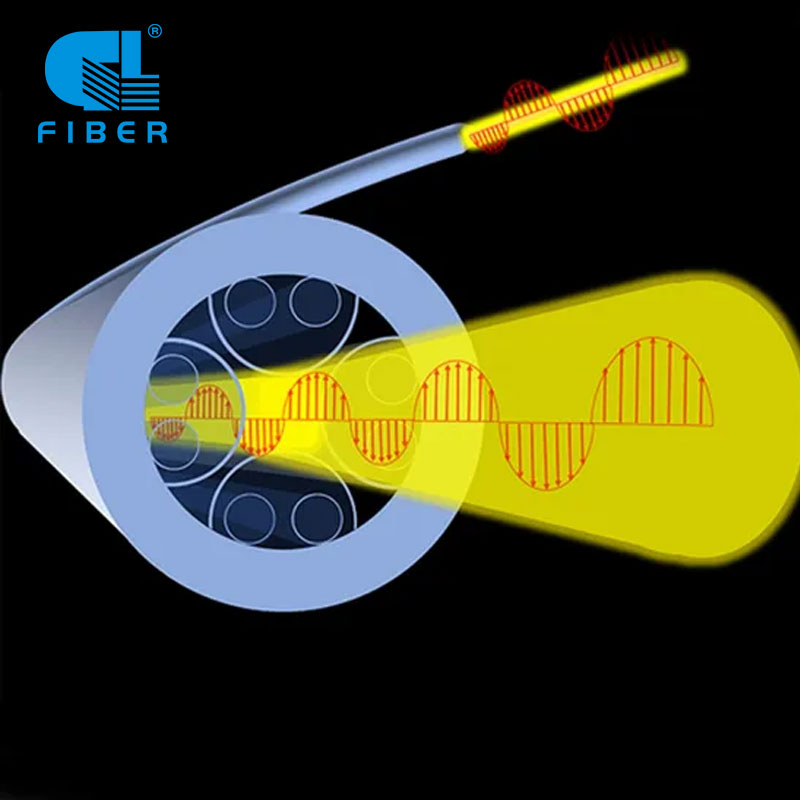
Unlike conventional single-mode fiber (SMF), where light propagates through solid glass, hollow core fiber guides light through a central air core. This fundamental design difference delivers three game-changing advantages:
Lower Latency: Light travels approximately 31–33% faster through air than through glass. HCF achieves latency of roughly 3.33 µs/km, compared to 4.9 µs/km in standard SMF – a 30%+ reduction that is critical for AI training clusters, high-frequency trading, and real-time cloud services.
Ultra-Low Attenuation: The best HCFs have achieved attenuation as low as 0.05 dB/km at 1550 nm – well below the 0.14 dB/km theoretical minimum for silica fiber. This enables much longer unamplified transmission spans and reduces the need for costly repeaters.
Virtually Zero Nonlinearity: Because over 99% of light travels through air rather than glass, nonlinear effects such as stimulated Raman scattering are approximately 1,000 times lower in HCF than in solid-core fiber. This allows higher optical launch power and simpler signal processing.
GL FIBER’s Hollow Core Fiber Solutions: Performance You Can Rely On
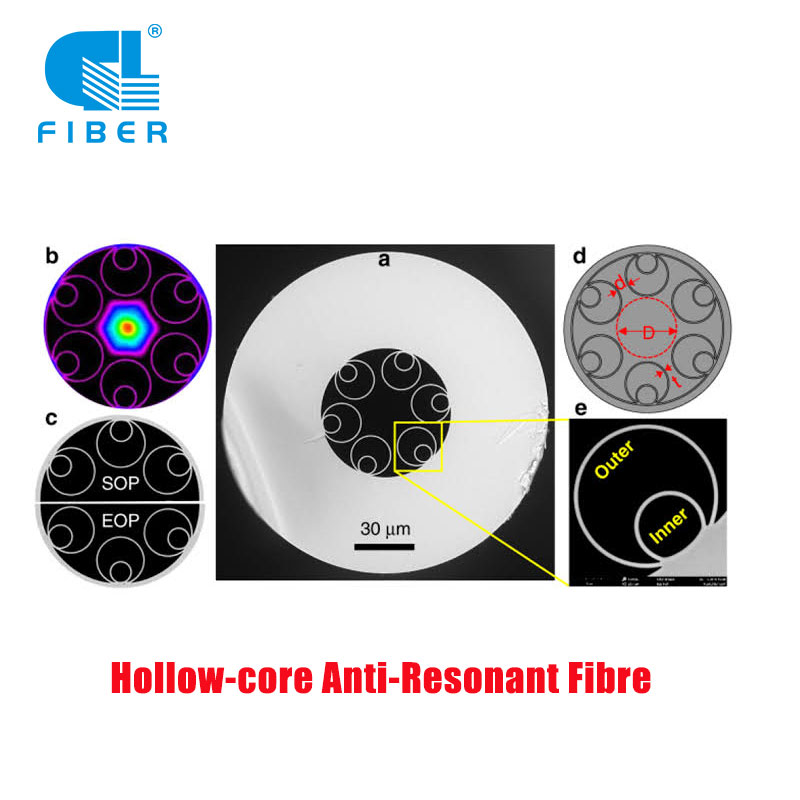
As a dedicated fiber optic manufacturer, GL FIBER offers high-quality anti-resonant hollow-core optical fiber (AR-HCF) and hollow core fiber cable products engineered for real-world deployment. Our solutions feature:
Parameter Typical Specification
Fiber Type Anti-Resonant Hollow-Core Fiber (AR-HCF)
Attenuation (1550 nm) 0.05–0.15 dB/km
Latency ~3.33 µs/km (approx. 33% lower than SMF)
Core Diameter Customizable (typical: 20–40 µm)
Transmission Band O, E, S, C, L bands
Cable Types Indoor/outdoor, termination-ready with standard connectors
Splicing Solutions Low-loss HCF-to-SMF adapters (<0.3 dB connection loss)
GL FIBER also provides hollow core fiber adapters that enable seamless optical power coupling between hollow core fibers and single-mode fibers with low insertion loss and low return loss – making integration into existing networks straightforward and cost-effective.
Global Market Outlook: A $2.6 Billion Opportunity by 2030
The hollow core fiber market is experiencing explosive growth. According to industry research:
The global hollow-core fiber market was valued at $1.23 billion in 2025** and is projected to reach **$2.6 billion by 2030, growing at a CAGR of 16.1%.
The hollow-core fiber backbone network market alone is expected to grow from $0.72 billion in 2026 to **$3.60 billion by 2031**, at a CAGR of 37.97%.
In the broader hollow core optical fibers category, the market is forecast to reach $733.5 billion by 2032 at a CAGR of 24.4%.
Regional growth is particularly strong in Asia-Pacific, which is projected to advance at a 38.43% CAGR through 2031. China, the world’s second-largest economy, is forecast to reach $213.7 billion by 2032 at a CAGR of 32.2%. North America currently holds the largest revenue share at 35.5%, but Asia-Pacific is rapidly catching up.
Key Applications Driving Demand
1. AI Data Centers and Hyperscale Cloud
AI workloads are exposing the physical limits of conventional fiber. As Jason Eichenholz, CEO of Relativity Networks, put it: “The networks being built for AI and hyperscale computing are exposing the physical limits of conventional fiber. Hollow core fiber removes those constraints — offering a step change in latency and signal performance”.
Major cloud providers are already deploying HCF at scale. In November 2024, Microsoft announced a 2-year plan to install 15,000 km of HCF cables between and within data centers processing data for Azure cloud services. AI data centers represent the perfect application for HCF, where ultra-low latency is critical for distributed processing across metro regions.
2. Telecom Backbone and 5G/6G Transport
Telecom backbone networks accounted for 39.12% of revenue share in the HCF backbone market in 2025. 5G and 6G transport networks are projected to expand at a 37.19% CAGR through 2031. With demonstrated attenuation below 0.1 dB/km and the ability to support longer unamplified spans, HCF is becoming the preferred choice for next-generation transport infrastructure.
3. High-Frequency Trading and Financial Networks
Latency-sensitive traders are willing to pay a premium to reduce transmission delay. Commercial deployments like the Guangdong-Hong Kong low-latency hollow-core fiber project have set records for the “world’s longest commercial hollow-core fiber optic cable” with latency as low as 0.93ms.
4. Quantum Communications and Sensing
HCFs are emerging in quantum key distribution systems, fiber optic gyroscopes, and precision sensors for aerospace and defense applications, where their low nonlinearity and phase coherence provide distinct advantages.
Current Pricing and Cost Considerations
While hollow core fiber remains more expensive than conventional single-mode fiber, prices are declining as commercialization accelerates:
China Mobile’s first commercial HCF procurement in 2025 saw中标 prices around ~36,000 RMB per core-km.
China Telecom’s 2025 HCF tenders had unit prices ranging from ~37,000–50,000 RMB per core-km.
Recent procurement for ~246 km of hollow-core cable saw bids exceeding 59,000 RMB per km (excluding tax).
By comparison, standard G.652D single-mode fiber traded around 20 RMB per core-km in 2025. The price premium reflects HCF’s superior performance – and as manufacturing scales, costs are expected to decline significantly. Industry consensus is that HCF will first prove its value in high-value, latency-critical applications before cost reductions enable broader adoption.
Recommendations for Procurement
For customers considering hollow core fiber adoption, GL FIBER offers the following guidance:
Identify Your Use Case First: HCF delivers maximum ROI in latency-sensitive applications – AI data center interconnects, high-frequency trading links, and long-haul backbone routes where amplifier spacing is a constraint.
Plan for Hybrid Networks: Most deployments today use HCF alongside conventional fiber. GL FIBER’s hollow core fiber adapters enable low-loss integration with existing SMF infrastructure.
Evaluate Total Cost of Ownership: While upfront costs are higher, HCF reduces the need for repeaters, amplifiers, and dispersion compensation – lowering both capital and operational expenditures over the fiber’s lifetime.
Partner with an Experienced Manufacturer: Splicing, termination, and field deployment of HCF require specialized expertise. GL FIBER provides end-to-end support from product selection to deployment guidance.
Act Now – Supply Is Tightening: With major cloud providers securing long-term capacity and manufacturing partnerships becoming a core competitive advantage, early adopters will secure the best pricing and availability.
The Bottom Line
Hollow core fiber is no longer a laboratory curiosity – it is a commercially available, field-proven technology that is redefining the limits of optical transmission. With the global market set to exceed $2.6 billion by 2030, and AI-driven demand accelerating adoption, the time to evaluate and invest in HCF is now.
GL FIBER is your trusted partner for anti-resonant hollow-core optical fiber and hollow core fiber cable solutions. Whether you’re upgrading a data center interconnect, building a low-latency financial network, or future-proofing your telecom backbone, we have the products, expertise, and support to help you succeed.